
Best AI Testing Tools in 2026 (Compared)

Software testing is going through its biggest shift in decades.
For years, teams relied on manual testing, scripted automation, and brittle UI selectors. Then came AI, but the first wave only improved automation; it didn’t replace the work behind it.
Now, in 2026, we’re seeing a new category emerge:
Autonomous, agent-driven testing
These are systems that don’t just help you write tests, they:
understand requirements
explore applications
validate outcomes
and continuously improve coverage
But here’s the challenge:
Most tools in the market still sit somewhere between manual effort + AI assistance, not true autonomy.
This guide breaks down the best AI testing tools in 2026, showing: how they actually work, what they’re best for, and where they fall short.
What Makes a Great AI Testing Tool in 2026?
Before comparing tools, it’s important to understand what actually differentiates them.
1. Autonomy vs Assistance
Many tools claim “AI,” but only assist with:
generating test steps
fixing locators
speeding up execution
Very few tools actually:
run tests independently
make decisions
adapt without human input
2. Test Creation Model
Testing tools now fall into four major categories:
Script-based (traditional automation)
Low-code/no-code (record & edit)
Requirement-driven (generate tests from docs)
Goal-driven (validate outcomes autonomously)
The further you move down this list, the less manual work required.
3. Maintenance Overhead
A key problem in QA has always been:
Tests breaking faster than they’re written
Good AI tools reduce maintenance. Great ones eliminate it entirely.
4. Exploration Capability
Most automation tools follow:
predefined paths
But real users don’t.
Modern AI tools should:
explore different flows
discover edge cases
validate unexpected behaviour
5. Workflow Fit
Testing doesn’t happen in isolation.
The best tools integrate into:
Jira
Linear
product requirements
sprint workflows
Best AI Testing Tools in 2026
1. Rova AI: Autonomous, Goal-Driven Testing
Best for: Product teams, startups, and QA teams that want testing without scripts
Rova AI introduces a fundamentally different approach to testing.
Instead of asking:
“What steps should I automate?”
Rova asks:
“What should be true about your product?”
From there, it handles everything else.
How it works
You can:
Give Rova a goal + URL
→ “Verify a user can add a product to cart”Tag @rova in Jira or Linear
→ it reads the ticket, extracts acceptance criteria, and runs testsUpload a PRD or requirements doc
→ it converts it into testable goals
Rova then:
explores your application like a real user
tries multiple paths to achieve the goal
adapts when flows change
captures screenshots and logs
explains results in plain language
Why it stands out
Unlike traditional tools, Rova:
doesn’t rely on scripts
doesn’t depend on selectors
doesn’t require maintenance
It’s not automating tests; it’s replacing the need to write them entirely.
Key strengths
Fully goal-driven testing
Autonomous exploration
Continuous regression without maintenance
Built for both technical and non-technical users
Limitations (V1)
Focused on modern apps (not legacy enterprise systems)
Verdict: The most forward-looking tool on this list, built for continuous product validation, not test execution.
2. Atto (Testsigma): Conversational AI Test Automation
Best for: Teams that want natural language-based automation without code
Atto by Testsigma improves how tests are created, but not how testing fundamentally works.
Instead of writing scripts, you:
describe tests in natural language
and the system converts them into structured automation
How it works
Users can:
write test instructions conversationally
generate test steps automatically
execute across web, mobile, and APIs
This reduces the barrier to entry for automation.
Where it fits
Atto is ideal for teams that:
still want control over test cases
prefer structured workflows
want faster test creation without coding
Limitations
Even with AI:
tests are still predefined
coverage only grows when you add tests
maintenance still exists
Verdict: A strong evolution of no-code automation, but still test-case-driven, not autonomous.
3. CoTester (TestGrid): Enterprise AI Testing Agent
Best for: Large enterprises with complex, regulated environments
CoTester represents the enterprise end of AI testing.
It uses Vision-Language Models (VLMs) to:
interpret UI visually
understand context
execute tests more intelligently
How it works
CoTester:
analyses UI visually (not just DOM)
executes structured tests with AI support
adapts to UI changes using its AgentRx engine
Where it excels
Enterprise integrations (ERP, Salesforce, ServiceNow)
Compliance and audit capabilities
Private cloud / on-prem deployment
Trade-offs
Requires demo + onboarding
Not self-serve
Complex setup
Expensive
Verdict: Extremely powerful, but built for enterprise QA programs, not product teams.
4. mabl: AI-Assisted UI Testing
Best for: Teams modernising UI test automation
mabl focuses on improving test automation through AI.
How it works
Users:
create tests using a visual interface
define flows and assertions
run them in CI/CD pipelines
AI helps by:
stabilizing tests
reducing flakiness
improving execution reliability
Limitations
Requires manual test creation
Limited exploration
Coverage grows manually
Verdict: A strong AI-assisted tool, but still within a traditional automation mindset.
5. Testim: AI for Test Stability and Speed
Best for: Teams prioritising fast, stable test execution
Testim is built to make automation:
faster
more reliable
easier to scale
How it works
It uses AI to:
create smart locators
reduce flaky tests
speed up execution
Limitations
No autonomous exploration
Requires predefined tests
No goal-based testing
Verdict: Excellent for stability, but not built for intelligent or autonomous testing.
6. Katalon: Full AI Testing Platform
Best for: Teams needing an all-in-one testing solution
Katalon combines:
automation
test management
analytics
How it works
Users can:
record tests
write scripts
generate tests using AI
It supports:
web
mobile
API
desktop
Limitations
Requires structured frameworks
Maintenance still needed
Not autonomous
Verdict: Powerful and flexible, but still tied to manual test ownership.
7. Tricentis Tosca: Enterprise Model-Based Testing
Best for: Large organisations with complex systems (SAP, legacy apps)
Tricentis focuses on model-based automation.
How it works
Teams:
create reusable models of applications
build tests from these components
scale across enterprise systems
Strengths
Enterprise coverage
SAP and legacy support
Risk-based testing
Limitations
High complexity
Expensive
Requires dedicated QA teams
Verdict: Ideal for enterprises, but far from lightweight or autonomous.
8. GPT Driver: AI-Powered Mobile Testing
Best for: Mobile engineering teams with CI/CD pipelines
GPT Driver focuses on mobile-first AI testing.
How it works
Uses visual execution
Runs tests based on instructions/prompts
Integrates with CI/CD pipelines
Strengths
Strong mobile support
Deterministic execution
Engineering-friendly
Limitations
Expensive ($799/month+)
Command-driven
No product-level workflows (Jira, PRDs)
Verdict: Strong for mobile automation, but not for end-to-end autonomous testing.
9. Scandium: Unified AI Testing Platform (Automation + Management + Autonomous Testing)
Best for: Teams that want a complete QA workflow across automation, test management, and autonomous testing
While most tools on this list focus on a single part of the testing lifecycle, Scandium Systems Inc provides a full testing ecosystem built around modern AI-powered workflows.
Instead of stitching together multiple tools for:
automation
test management
reporting
and exploratory validation
Scandium offers an integrated suite:
What’s included in the Scandium suite
1. Scandium Auto: AI-Powered Test Automation
A no-code automation platform for:
web testing
mobile testing
API testing
It allows teams to:
record and generate test cases
execute tests in parallel
integrate into CI/CD pipelines
collaborate across teams
Unlike traditional tools like Selenium or Cypress, Scandium Auto reduces:
scripting complexity
setup overhead
maintenance burden
2. TestPod: AI-Powered Test Management
A lightweight alternative to tools like TestRail and Zephyr.
TestPod helps teams:
organise test cases and suites
track manual test execution
collaborate across QA and product teams
manage QA workflows without spreadsheets
It’s designed to remove the “enterprise bloat” while still giving teams structure.
3. Rova AI: Autonomous Testing Agent
The newest layer of the stack.
Rova AI handles:
goal-driven testing
autonomous exploration
continuous validation
You can:
give it a goal + URL
tag it in Jira or Linear
upload a PRD
And it:
extracts goals
runs tests
reports outcomes
No scripts. No setup. Just results.
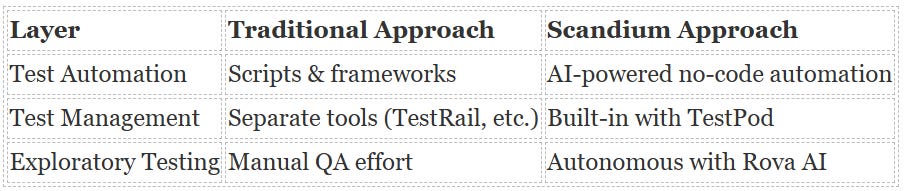
Why Scandium stands out
Most teams today use:
one tool for automation
another for test management
and manual processes for exploratory testing
Scandium combines all three into a single ecosystem:
When to choose Scandium
Choose Scandium if:
You want a complete QA stack, not isolated tools
You want to combine automation + management + autonomous testing
You’re scaling QA without increasing team size
You want flexibility between:
structured automation (Scandium Auto)
and autonomous testing (Rova AI)
Verdict: While most tools solve a single layer of testing, Scandium is one of the few platforms building toward a fully integrated, AI-native QA ecosystem.
The Real Shift: Automation → Autonomy
Most tools still follow:
Write tests → Run tests → Maintain tests
Even with AI, the responsibility stays with the team.
Rova AI changes that to:
Define goals → Rova explores → Rova validates → Rova reports
This removes:
scripting
test maintenance
rigid execution paths
And introduces:
continuous exploration
adaptive execution
outcome-based validation
Which AI Testing Tool Should You Choose?
Choose Rova AI if:
You want no scripts, no maintenance
You want testing driven by goals, not steps
You want continuous product validation
Choose Atto, mabl, Katalon, Testim if:
You prefer structured automation
You want AI-assisted workflows
You manage test suites internally
Choose CoTester or Tricentis if:
You are an enterprise
You need compliance and infrastructure
Choose GPT Driver if:
You are mobile-first
You rely heavily on CI/CD
Final Thoughts
AI testing tools are no longer just about automation. They’re redefining the role of testing itself.
Traditional tools help you:
automate execution
Modern tools like Rova AI help you:
continuously verify your product, without writing tests
That’s where the industry is heading.
Try Rova AI
Visit: www.rova.qa. Give it a goal + your product URL.
No scripts. No setup. Just results.